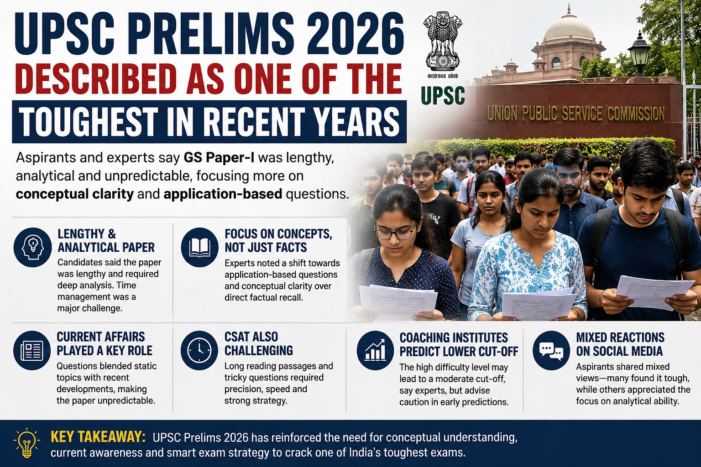
Aspirants Face Lengthy and Analytical Question Paper
The Union Public Service Commission’s Civil Services Preliminary Examination 2026 has sparked widespread debate among aspirants after many candidates described the General Studies Paper-I as one of the toughest papers seen in recent years. Students across examination centres reported that the paper was unusually lengthy and required deep conceptual understanding rather than straightforward memorisation.
Several candidates said managing time became a major challenge because many questions demanded careful reading and multi-layered analysis. Aspirants noted that even familiar topics were framed in unconventional ways, making elimination techniques difficult.
Focus Shifts From Facts to Application-Based Learning
According to candidates and coaching experts, the examination placed greater emphasis on analytical thinking, interpretation, and conceptual clarity. Questions from subjects such as polity, economy, environment, history, and science reportedly tested the ability to connect concepts instead of recalling isolated facts.
Experts observed that UPSC appears to be continuing its trend of rewarding candidates with strong understanding and balanced preparation. Many aspirants felt the paper reduced the advantage of rote learning and encouraged broader comprehension of current affairs and governance-related issues.
Current Affairs Played a Crucial Role
Candidates also pointed out that several questions blended static syllabus areas with recent developments. This approach reportedly increased the difficulty level because students had to apply contemporary knowledge to traditional subjects.
Many aspirants said the current affairs section was unpredictable, with fewer direct questions from commonly expected topics. Some students felt that extensive newspaper reading and issue-based preparation proved more useful than relying solely on coaching material.
CSAT Paper Also Demanded Careful Time Management
While General Studies Paper-I attracted most discussion, several candidates reported that the Civil Services Aptitude Test (CSAT) was also moderately challenging. Reading comprehension passages were described as lengthy, while logical reasoning and quantitative aptitude sections required precision and speed.
Aspirants from non-technical backgrounds particularly noted that balancing both papers demanded strong exam strategy and mental stamina.
Coaching Institutes Predict Lower Cut-Off Trends
Following the examination, several coaching institutes suggested that the overall difficulty level may influence the expected cut-off marks. Experts believe the cut-off could remain moderate if the majority of candidates found the paper challenging.
However, mentors also cautioned students against relying entirely on early predictions, noting that UPSC evaluation patterns often produce unexpected outcomes.
Social Media Filled With Mixed Reactions
Soon after the examination concluded, social media platforms were flooded with reactions from aspirants discussing tricky questions and unexpected themes. While many students described the paper as stressful, others welcomed the shift towards analytical assessment, arguing that it better reflects the qualities required in civil servants.
The examination once again highlighted the highly competitive and evolving nature of the UPSC selection process, where adaptability and conceptual understanding continue to play a decisive role.

UPSC Prelims 2026 Described as One of the Toughest in Recent Years added by AdminEdu on
View all posts by AdminEdu →