Concept-Based Education Gains Momentum in Schools
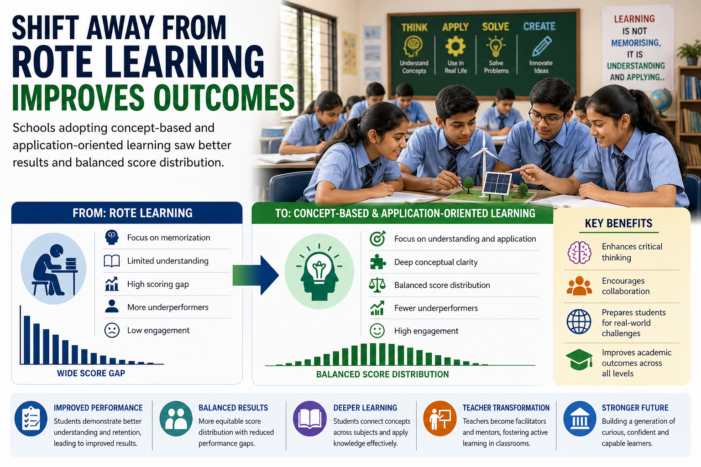
A growing number of schools are moving away from traditional rote memorization methods and embracing concept-based, application-oriented learning approaches. Educators report that this shift is leading to improved academic performance, deeper understanding, and more balanced score distribution among students.
Better Understanding, Not Just Memorization
Unlike rote learning, which focuses on repetition and recall, concept-based learning encourages students to understand the “why” behind subjects. This method integrates real-world applications, problem-solving, and critical thinking. Teachers note that students are now better equipped to apply knowledge across different subjects rather than relying on memorized answers.
Improved Academic Performance Across Levels
Schools that have adopted this approach are witnessing more consistent results. Instead of a wide gap between high and low performers, exam scores show a more balanced distribution. This suggests that a larger proportion of students are grasping core concepts effectively, reducing the number of underperformers.
Enhanced Critical Thinking and Creativity
Application-oriented teaching methods—such as project-based learning, case studies, and interactive discussions—are helping students develop analytical skills. Students are increasingly able to think independently, ask meaningful questions, and explore multiple solutions to a problem.
Teachers Adapt to New Pedagogical Methods
Educators are undergoing training to transition from lecture-based instruction to facilitative teaching. Classrooms are becoming more interactive, with teachers guiding students through concepts rather than dictating information. Digital tools and experiential learning techniques are also being integrated to support this transformation.
Positive Impact on Competitive Exams
Experts believe that this shift will benefit students preparing for competitive exams, where conceptual clarity and application are key. Students trained under this system are likely to perform better in problem-solving sections and analytical assessments.
Challenges and the Road Ahead
While the transition shows promising results, challenges remain. Some schools face resource constraints, and not all teachers are equally trained in modern pedagogical techniques. However, education boards and institutions are increasingly investing in teacher development and curriculum redesign to sustain this change.
The move away from rote learning marks a significant transformation in the education system. By focusing on understanding and application, schools are not only improving academic outcomes but also preparing students with skills essential for the future.

Shift Away from Rote Learning Improves Student Outcomes added by AdminEdu on
View all posts by AdminEdu →