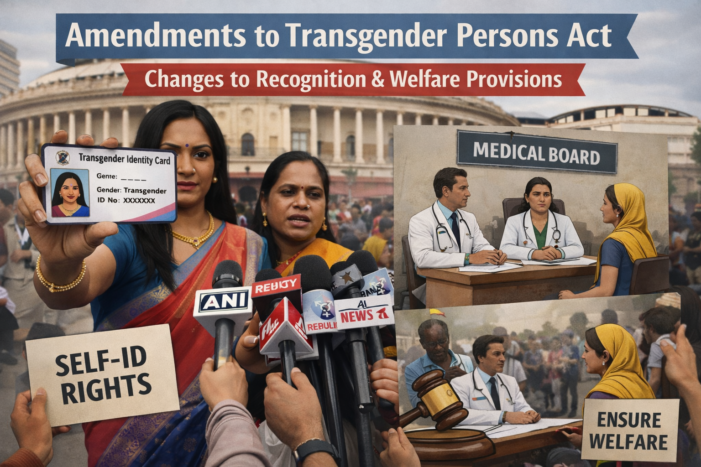
Background of the 2019 Law
The Government of India has proposed amendments to the Transgender Persons (Protection of Rights) Act, 2019, a landmark law enacted to safeguard the rights of transgender individuals and promote their welfare. The Act prohibits discrimination against transgender persons in areas such as education, employment, healthcare, housing, and access to public services. It also established mechanisms for issuing identity certificates and implementing welfare schemes for the community.
The proposed amendment aims to modify certain provisions of the law to revise how transgender identity is recognised and how welfare measures are implemented.
Key Changes in the Proposed Amendment
The amendment bill seeks to introduce a revised definition of transgender persons and update the procedures for legal recognition. The new framework proposes a more specific definition that focuses on socio-cultural identities such as hijra, kinner, aravani, and jogta, as well as individuals with certain biological variations.
Under the proposal, the earlier provision allowing recognition based on self-perceived gender identity may be removed. Instead, the identification process could involve verification through a designated medical board whose recommendation would be considered by the District Magistrate while issuing the identity certificate.
Revised Process for Identity Certification
Currently, transgender persons can apply for an identity certificate from the district administration, enabling them to access government benefits and official recognition. The amendment proposes to strengthen this process by introducing medical verification mechanisms before such certificates are issued.
The bill also includes provisions allowing recognised individuals to update their first name and other personal details in official documents once their identity certificate is issued.
Welfare and Legal Protection Measures
In addition to changes in recognition procedures, the amendment aims to strengthen welfare and legal protections for transgender persons. The proposal includes provisions to enhance safeguards against crimes and discrimination targeting the community.
The government has stated that the objective of the amendment is to create a clearer legal framework and ensure that welfare schemes and benefits reach individuals who face significant social exclusion due to their gender identity.
Debate and Concerns
The proposed changes have sparked debate among activists, legal experts, and community members. Some argue that removing the self-identification clause may restrict personal autonomy and undermine earlier judicial recognition of gender self-determination. Others believe that a clearer definition could improve implementation of welfare policies and ensure targeted support for marginalized groups.
Way Forward
The amendment bill is currently under consideration in Parliament. If passed, it will significantly reshape the framework governing recognition, legal rights, and welfare mechanisms for transgender persons in India, potentially influencing future policy and social inclusion initiatives.

Proposed Amendment to the Transgender Persons Act Introduces Changes to Recognition and Welfare added by AdminEdu on
View all posts by AdminEdu →