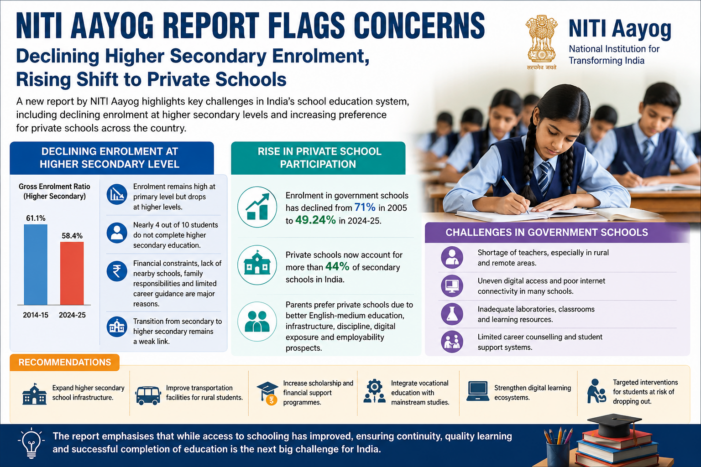
India’s school education system has achieved significant progress in expanding access to education, but fresh concerns have emerged regarding student retention and changing enrolment patterns. A recent report released by NITI Aayog highlighted a decline in enrolment at higher secondary levels and an increasing shift of students toward private schools across the country.
Declining Enrolment at Higher Secondary Level
According to the report, enrolment rates remain strong at the primary level, but participation drops considerably as students move into secondary and higher secondary education. The study noted that a substantial number of students discontinue their studies before completing Class 12.
Economic pressures, limited access to senior secondary schools in rural areas, family responsibilities, and lack of career guidance were identified as some of the major reasons behind the decline in retention at higher levels of education.
The report observed that the transition from secondary to higher secondary education remains one of the weakest stages in India’s education system, particularly in economically weaker and remote regions.
Rise in Private School Participation
The report also highlighted the growing preference for private schools among parents. Over the past two decades, enrolment in government schools has gradually declined while private institutions have expanded their presence in both urban and semi-urban areas.
Parents increasingly prefer private schools due to factors such as English-medium education, digital learning exposure, improved infrastructure, stricter academic monitoring, and perceptions of better career opportunities for students.
Private schools now account for a significant share of secondary and higher secondary education enrolment, reflecting changing aspirations among families.
Government Schools Face Key Challenges
Despite improvements in infrastructure and access to education, the report pointed out that many government schools continue to face shortages of teachers, inadequate digital facilities, and gaps in laboratory and classroom resources.
Several states still struggle with uneven teacher distribution, particularly in rural districts where schools face difficulties in recruiting qualified staff for science, mathematics, and language subjects.
The report also noted that digital access remains uneven, with many schools lacking stable internet connectivity and modern learning tools.
Need for Stronger Retention Policies
To address the challenges, the report recommended strengthening higher secondary infrastructure, expanding scholarship support, improving transportation facilities for rural students, and integrating vocational education into mainstream schooling.
The think tank also suggested targeted interventions for students at risk of dropping out, especially during the transition from Class 10 to higher secondary education.
Education experts believe that while India has largely succeeded in improving access to schooling, the next major challenge lies in ensuring continuity, quality learning, and successful completion of education at higher levels.

NITI Aayog Highlights Concerns Over Higher Secondary Enrolment and Rise of Private Schools added by AdminEdu on
View all posts by AdminEdu →