Published: October 8, 2026
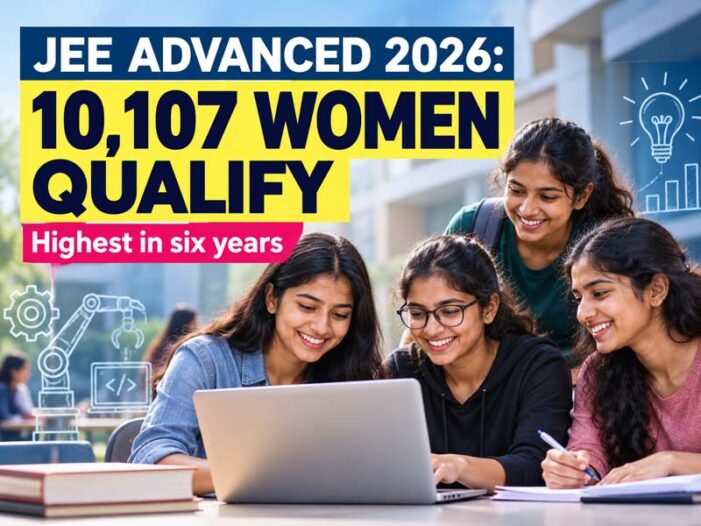
The number of women qualifying for JEE Advanced 2026 has crossed the 10,000 mark for the first time in six years, marking a significant milestone for female participation in India’s highly competitive engineering entrance examination.
According to the Joint Implementation Committee (JIC) report prepared by IIT Roorkee, 10,107 women candidates qualified for JEE Advanced 2026. The figure is the highest recorded in the six-year period covered by the report.
10,107 Women Qualify JEE Advanced 2026
A total of 43,112 women registered for JEE Advanced 2026, while 40,562 appeared in both Paper 1 and Paper 2. Of these, 10,107 women qualified for the examination.
The qualification rate among registered women candidates rose to 23.4% in 2026, compared with 21.7% in 2025. This means that nearly one in every four women who registered for JEE Advanced this year qualified.
JEE Advanced 2026 Women Candidates: Key Statistics
| Particular | 2026 |
|---|---|
| Women registered | 43,112 |
| Women appearing in both papers | 40,562 |
| Women qualifying | 10,107 |
| Qualification rate among registered women | 23.4% |
| Total candidates qualifying | 56,880 |
| Women’s share of total qualifiers | About 17.8% |
The overall JEE Advanced 2026 examination saw 1,87,389 candidates register, of whom 1,79,694 appeared in both papers. A total of 56,880 candidates qualified.
Female Qualification Rate Reaches Six-Year High
The rise in the number of women qualifiers is accompanied by a significant improvement in the female qualification rate.
In 2025, 43,413 women registered for JEE Advanced and 9,404 qualified, giving a qualification rate of 21.7%. In 2026, registrations fell slightly to 43,112, but the number of qualifiers increased to 10,107.
This pushed the qualification rate to 23.4%, the highest level reported in the six-year JIC comparison.
The trend indicates that the increase in female qualifiers was not simply the result of a larger number of women appearing for the examination. A higher proportion of registered women successfully cleared the qualification threshold this year.
Top Female Candidate Secures AIR 77
The top-performing female candidate in JEE Advanced 2026 was Arohi Deshpande, who secured All India Rank (AIR) 77 with a score of 280 out of 360 marks.
Her subject-wise scores were:
- Mathematics: 101 marks
- Physics: 86 marks
- Chemistry: 93 marks
- Total: 280 marks
The overall JEE Advanced 2026 topper, Shubham Kumar, scored 330 out of 360 marks and secured the top position in the Common Rank List.
More Women Secure IIT Seats
The increase in the number of women qualifying JEE Advanced comes alongside continued efforts by the IITs to improve women’s representation in undergraduate engineering programmes.
In 2026, 3,814 female-only seats, including female supernumerary seats, were allotted to women candidates. A further 37 female candidates secured seats through the gender-neutral pool.
This resulted in women accounting for approximately 20.2% of IIT seat allocations in 2026, continuing the significant increase in female representation seen since the introduction of supernumerary seats for women.
Supernumerary Seats Help Increase Female Representation
The IITs introduced the Supernumerary Seats Scheme in 2018 with the objective of increasing the representation of women in undergraduate programmes.
The scheme allows additional seats to be created for female candidates without reducing the number of seats available to male candidates. Over the years, the proportion of women entering IITs has consequently increased from the levels seen before the scheme was introduced.
The latest JEE Advanced figures suggest that female participation is continuing to strengthen, both in terms of examination qualification and IIT admissions.
JEE Advanced 2026 Shows Broader Changes in Qualification Trends
The JIC report also highlighted significant changes among candidates from different social categories.
The qualification rate among Scheduled Caste (SC) candidates increased to 50.16%, while the rate for Scheduled Tribe (ST) candidates rose to 42.14%. SC qualifiers increased from 12,499 in 2025 to 15,856 in 2026, while ST qualifiers increased from 5,008 to 6,379.
At the same time, the qualification rate for General category candidates declined from 43% in 2025 to 39.8% in 2026, while the OBC-NCL qualification rate fell slightly to 17.5%.
What the JEE Advanced 2026 Numbers Mean
The latest figures point to a gradual change in the gender profile of India’s premier engineering entrance examination.
More than 10,000 women qualifying in a single year represents an important milestone. Female registrations have also increased substantially over the longer term, while the proportion of women successfully clearing the examination has improved.
For aspiring female engineering students, the figures provide further evidence of the growing opportunities available through the IIT admission system.
However, the number of women qualifying and the number ultimately securing IIT seats remain different measures. While 10,107 women qualified JEE Advanced in 2026, around 3,851 women received IIT seat allocations through female-only and gender-neutral seats.
JEE Advanced 2026: Key Takeaways
- 10,107 women qualified JEE Advanced 2026.
- It is the first time in six years that female qualifiers have crossed 10,000.
- 43,112 women registered for the examination.
- 40,562 women appeared in both papers.
- Female qualification rate increased to 23.4%, up from 21.7% in 2025.
- The top female candidate secured AIR 77 with 280 marks.
- 3,814 female-only IIT seats were allotted in 2026.
- Another 37 women secured seats through the gender-neutral pool.
- Women accounted for approximately 20.2% of IIT seat allocations.
Conclusion
The JEE Advanced 2026 results mark a notable milestone for women in engineering education in India. With 10,107 women qualifying, the number has crossed the 10,000 mark for the first time in six years, while the female qualification rate has reached its highest level in the period covered by the JIC report.
The numbers suggest that women’s participation and performance in one of India’s toughest engineering entrance examinations are continuing to strengthen. With IITs also maintaining dedicated supernumerary seats for women, female representation in the country’s premier engineering institutions is expected to remain an important focus in the years ahead.
Source: JEE (Advanced) 2026 official results and Joint Implementation Committee report.

JEE Advanced 2026: Women Qualifiers Cross 10,000 for the First Time in Six Years added by AdminEdu on
View all posts by AdminEdu →