Schools Across States Adjust Academic Schedules
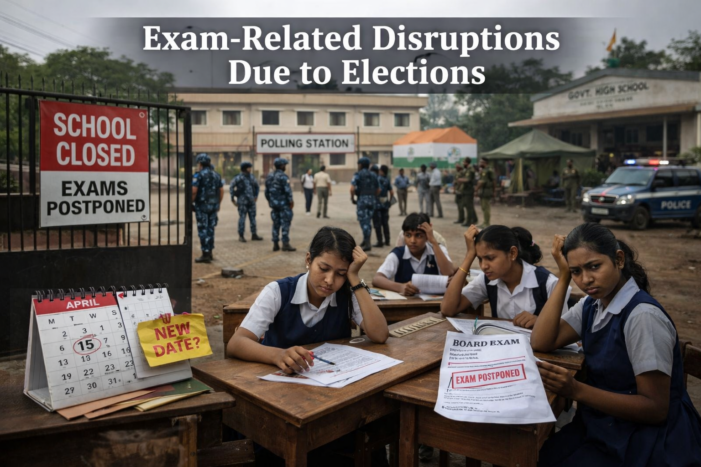
As election activities intensify across parts of India, several schools in states such as Tamil Nadu and West Bengal are facing significant disruptions to their academic calendars. With school premises being requisitioned for polling stations and security forces deployed extensively, administrators are being forced to rethink examination schedules and classroom operations.
Rescheduling of Exams Becomes Inevitable
In many districts, examinations originally planned for late March and early April have been postponed or rescheduled. School authorities cite the unavailability of classrooms and staff, as many teachers are assigned election duties. Revised timetables are being communicated to students and parents, though the sudden changes have created uncertainty and stress among learners preparing for crucial assessments.
Shift to Online Classes Gains Momentum
To minimize academic loss, several institutions have temporarily transitioned to online classes. While this ensures continuity in teaching, challenges such as unequal access to digital devices and internet connectivity persist, particularly in rural and semi-urban areas. Educators are attempting to balance both offline and online modes to accommodate all students.
Security Deployment Impacts Infrastructure Use
Large-scale deployment of police and paramilitary forces has led to the occupation of school buildings as temporary camps and polling booths. This has restricted access to essential infrastructure, including examination halls, laboratories, and libraries, further complicating academic planning.
Parents and Students Voice Concerns
Parents have expressed concerns about the impact of these disruptions on students’ academic performance and mental well-being. Students preparing for board and competitive exams are particularly affected, as uncertainty over schedules hampers their preparation strategies.
Government and Education Boards Respond
State education departments have acknowledged the challenges and are working to ensure minimal disruption. Officials have directed schools to maintain flexibility in scheduling and prioritize student welfare. In some cases, buffer periods have been introduced in the academic calendar to accommodate delays.
Balancing Democracy and Education
While elections remain a cornerstone of democracy, their logistical demands often intersect with the functioning of public institutions like schools. The current situation highlights the need for long-term planning to ensure that essential academic activities continue smoothly, even during large-scale national or state events.

Exam-Related Disruptions Due to Elections added by AdminEdu on
View all posts by AdminEdu →