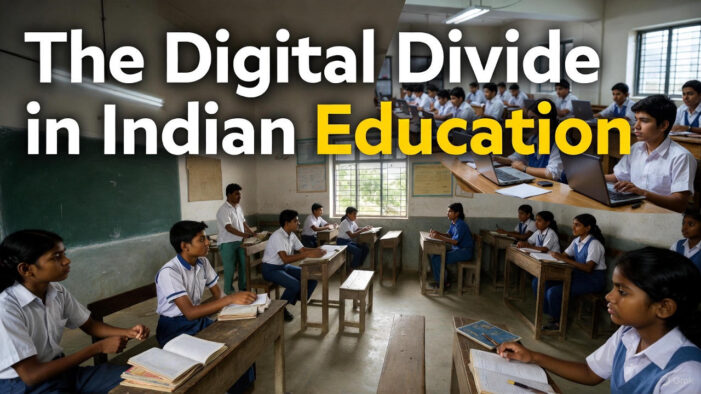
Every year, the Ministry of Education releases the Unified District Information System for Education Plus (UDISE+) report—a massive dataset that captures the state of school education across India. The 2023-24 report, released in early 2025, contains a statistic that should alarm anyone who believes digital literacy is the future of learning:
Only 46.9% of government schools in India have functional internet access.
In plain numbers: more than half of India’s 1.07 million government schools—where roughly 65% of the country’s school-going children study—are cut off from the internet in 2024.
The Urban-Rural Chasm in One Table
| Category | Schools with Internet (%) | Schools with Computers (%) | Schools with Functional Computer Lab (%) |
|---|---|---|---|
| Government schools | 46.9% | 59.2% | 38.4% |
| Private schools | 89.1% | 92.6% | 81.7% |
| Rural government schools | 41.2% | 52.8% | 32.1% |
| Urban government schools | 68.7% | 78.9% | 59.6% |
(Source: UDISE+ 2023-24)
The gap is glaring. A child studying in a private urban school is more than twice as likely to have internet access than a child in a rural government school. Even the availability of computers (forget internet) drops sharply once you leave city limits.
Why This Matters Now More Than Ever
- Post-COVID learning loss is still being recovered
The pandemic taught us that schools without digital infrastructure simply disappeared for two academic years. Many children never came back. We cannot afford a repeat. - National Curriculum Framework and NEP 2020 hinge on technology
Coding, computational thinking, and AI literacy are now part of the curriculum from Class 6 onwards. How do you teach coding without computers or the internet? - Competitive exams and higher education are fully digital
From CUET and NEET registration to scholarship forms and college applications—everything happens online. A student who has never used the internet until Class 12 is already at a massive disadvantage. - Teacher training platforms are online
DIKSHA, NISHTHA, and state-level training modules assume teachers have access. In schools without connectivity, teachers remain digitally illiterate too.
Beyond Internet: The Electricity Problem No One Talks About
The report quietly reveals another uncomfortable truth: nearly 9% of government schools still do not have electricity (down from 14% a decade ago, but still unacceptable in 2024). You can install optical fibre and computers all you want—if the lights don’t stay on, nothing works.
Where the Problem Is Worst
States lagging furthest behind in internet access for government schools (2023-24):
- Bihar: 24.8%
- Assam: 31.2%
- Jharkhand: 34.6%
- Odisha: 38.9%
- Uttar Pradesh: 41.3%
These are also the states with the highest enrollment in government schools and the lowest learning outcomes.
What Can Be Done (Realistically)
- Prioritise electricity and last-mile broadband
BharatNet has laid fibre up to the gram panchayat level in most places. The bottleneck now is the “last 500 metres” to the school and reliable power backup. - Shift from “computer labs” to “device-per-child” models in secondary schools
PM-SHRI schools and some state initiatives (e.g., Tamil Nadu, Kerala, Himachal) have shown that giving every child a tablet or laptop dramatically improves utilisation. - Use satellite and emerging LEO options
Starlink, Project Kuiper, and homegrown solutions like Jio’s satellite plans can bypass terrestrial bottlenecks in remote areas. - Offline-first digital content
Tools like Kolibri, DIKSHA offline caches, and state-level content on pen drives can work even with intermittent connectivity. - Budget honestly
The Parliamentary Standing Committee on Education (2024) noted that the actual expenditure on Samagra Shiksha’s ICT component has been consistently under 40% of approved budgets. Money is approved but not spent.
The Bottom Line
The UDISE+ 2023-24 numbers are not just statistics; they are a daily reality for millions of children who wake up knowing that the world is moving online while their school remains frozen in time.
Closing India’s digital divide in education is no longer a “nice-to-have.” It is the difference between producing a generation that can compete globally and one that starts the race several laps behind.
Until every government school—urban or rural, plains or hills—has reliable electricity, internet, and trained teachers who can use them, the promise of “Sabko Shiksha, Achhi Shiksha” will remain incomplete.
The data is out. The excuses should now be over.

The Digital Divide in Indian Education: What the UDISE+ 2023-24 Report Really Tells Us added by AdminEdu on
View all posts by AdminEdu →