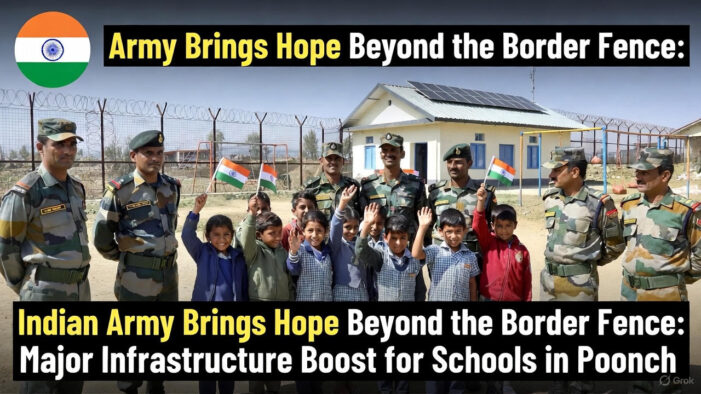
In the rugged, high-altitude terrain of Jammu and Kashmir’s Poonch district, where villages lie literally beyond the India-Pakistan border fence, four government schools have just received a transformational upgrade, thanks to a heartfelt collaboration between the Indian Army and a committed non-governmental organisation.
The project, executed under the Army’s Sadbhavana initiative, saw infrastructure improvements worth several lakhs of rupees delivered to schools in forward villages that are often cut off from mainstream development due to their sensitive location. New classrooms, renovated buildings, upgraded toilets, drinking-water facilities, playground equipment, and even solar lighting now stand where, until recently, children studied in cramped, leaking rooms with almost no amenities.
Why This Matters More Than the Price Tag
Living beyond the fence means restricted civilian movement, limited government contractor access, and years of delayed civic projects. Many of these villages fall in “no-construction” zones for security reasons, leaving school buildings in a state of perpetual disrepair. Parents often hesitate to send younger children—especially girls—to schools that lack boundary walls or functional toilets.
By stepping in where regular civilian agencies face hurdles, the Army has not only fixed roofs and floors but has reopened the door to education for hundreds of children who might otherwise have dropped out.
What Exactly Was Done?
Though exact figures vary by school, the combined package across the four institutions included:
- Complete renovation of classrooms (new flooring, plastering, painting, doors & windows)
- Construction and upgradation of separate toilet blocks for boys and girls
- Installation of RO water purification systems and overhead tanks
- Solar-powered lighting for evening study hours and security
- Levelling and equipping of playgrounds with slides, see-saws and sports kits
- Provision of desks, benches, blackboards, and teaching aids
Local teachers say attendance has already jumped, especially among girls, now that the schools finally have safe, hygienic sanitation facilities.
A Quiet Revolution in Olive Green
Operation Sadbhavana (“goodwill”) has been the Indian Army’s long-running people-friendly programme in Jammu & Kashmir and Ladakh for over two decades. From building schools and orphanages to running medical and veterinary camps, the initiative has touched thousands of lives in the most remote corners of the region.
In Poonch and nearby Rajouri, where the Army maintains a heavy forward presence because of the LoC, soldiers often double up as community builders during peacetime. Locals warmly refer to these projects as “fauji schools” and “fauji bridges,” a testimony to the trust that years of such outreach have earned.
The Bigger Picture
At a time when headlines about Jammu & Kashmir are still dominated by security issues, stories like this remind us that nation-building and area-domination go hand in hand along our borders. When a child in a remote village beyond the fence can now study under a solid roof with clean water and light after sunset, the idea of India grows a little stronger in hearts that geography and history once kept distant.
The Indian Army didn’t just renovate four school buildings in Poonch.
It rebuilt hope, one classroom at a time.
Jai Hind. 🇮🇳

Indian Army Brings Hope Beyond the Border Fence: Major Infrastructure Boost for Schools in Poonch added by AdminEdu on
View all posts by AdminEdu →