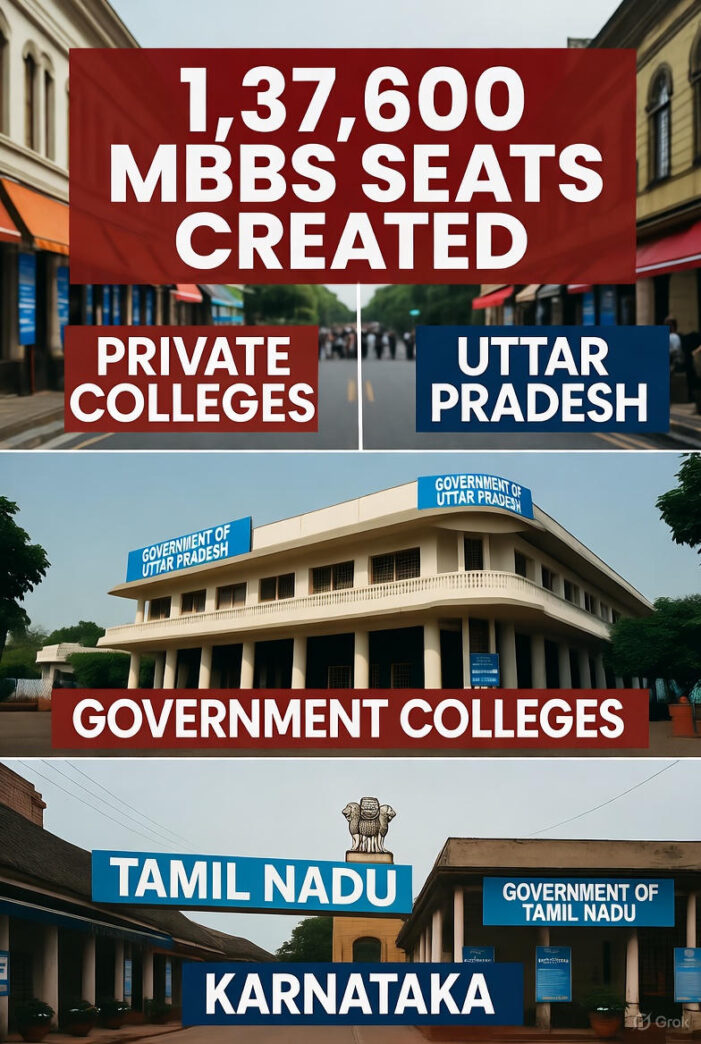
New Delhi, October 20, 2025 – India’s medical education sector has achieved a monumental milestone with the approval of 1,37,600 MBBS seats across the country, bolstered by the addition of 10,650 new seats and the establishment of 41 new medical colleges. This unprecedented expansion marks a significant step toward addressing the nation’s growing demand for healthcare professionals, but it also raises critical questions about accessibility and affordability, as private institutions increasingly dominate the landscape.
A Landmark Achievement in Medical Education
The surge in MBBS seats represents a transformative moment for India’s healthcare education system. The addition of 10,650 new seats and 41 new colleges, approved by the National Medical Commission (NMC), reflects the government’s commitment to strengthening the medical workforce. This expansion brings the total number of MBBS seats to 1,37,600, a remarkable increase from just 51,348 seats a decade ago. The growth aligns with India’s ambition to improve its doctor-to-population ratio, currently at 1:834, which, while better than the World Health Organization’s recommended 1:1,000, still falls short of meeting the country’s diverse healthcare needs.
Uttar Pradesh has emerged as the frontrunner in this expansion, boasting over 10,000 MBBS seats, the highest in the country. The state’s investment in medical infrastructure, coupled with strategic policy initiatives, has positioned it as a leader in medical education. Tamil Nadu and Karnataka follow closely, with robust networks of both government and private medical colleges contributing to their high seat counts. These three states alone account for a significant portion of the nation’s MBBS capacity, underscoring regional disparities in educational infrastructure.
Privatization: A Double-Edged Sword
While the increase in seats is a cause for celebration, the growing dominance of private institutions has sparked concerns about affordability and equity. Since the liberalization of medical education regulations in 2015, private colleges have outpaced their government counterparts in seat availability. Today, private institutions account for more MBBS seats than public ones, a trend that has raised alarms among policymakers, educators, and students.
The cost of medical education in private colleges often ranges between ₹50 lakh and ₹1 crore for the entire MBBS program, compared to ₹1–5 lakh in government colleges. This stark contrast has made medical education increasingly inaccessible to students from lower-income backgrounds, even as the total number of seats grows. Critics argue that the privatization trend risks creating a two-tiered system, where only affluent students can afford quality medical education, potentially exacerbating inequalities in the healthcare workforce.
Dr. Anjali Sharma, a health policy expert, noted, “The expansion of MBBS seats is a commendable achievement, but we must address the affordability crisis. Without targeted interventions, such as increased subsidies or scholarships, the dream of becoming a doctor will remain out of reach for many talented students.”
Regional Dynamics and Infrastructure Growth
The distribution of MBBS seats highlights significant regional variations. Uttar Pradesh’s dominance, with over 10,000 seats, is attributed to its large population and proactive state policies aimed at expanding medical education. Tamil Nadu, with its well-established healthcare ecosystem, and Karnataka, a hub for medical innovation, follow closely, each contributing thousands of seats. However, states in the Northeast and smaller union territories continue to lag, with limited medical colleges and seat availability, raising concerns about equitable access to medical education across India.
The addition of 41 new medical colleges is a critical component of this expansion. These institutions, spread across various states, include both government and private colleges, with a focus on underserved regions. The NMC has prioritized quality control, ensuring that new colleges meet stringent infrastructure and faculty requirements. However, challenges such as faculty shortages and inadequate clinical facilities in some private institutions remain hurdles to maintaining educational standards.
Policy Reforms and Future Implications
The surge in MBBS seats can be traced back to reforms initiated in 2015, which streamlined the approval process for new medical colleges and relaxed certain regulatory requirements. These changes, intended to accelerate the growth of medical education, have yielded impressive results but have also fueled the privatization boom. The government has introduced measures to address affordability, including scholarships and loan schemes, but these have been criticized as insufficient to bridge the gap.
Looking ahead, experts emphasize the need for a balanced approach that prioritizes quality, affordability, and equitable distribution. Increasing the number of government medical colleges, enhancing faculty training, and regulating private college fees are among the proposed solutions. Additionally, integrating technology, such as simulation-based learning, could help address infrastructure challenges in new colleges.
A Step Toward a Healthier Future
The milestone of 1,37,600 MBBS seats is a testament to India’s commitment to building a robust healthcare system. With a growing population and increasing healthcare demands, the expansion of medical education is a critical step toward ensuring adequate medical professionals to serve the nation. However, the challenges of privatization and affordability must be addressed to ensure that this growth benefits all sections of society.
As India celebrates this historic achievement, the focus now shifts to sustaining quality and accessibility in medical education. By addressing these challenges, the country can ensure that its expanded medical workforce not only meets quantitative targets but also delivers equitable, high-quality healthcare to every citizen.

Historic Surge in MBBS Seats: India’s Medical Education Reaches New Heights Amid Affordability Concerns added by AdminEdu on
View all posts by AdminEdu →