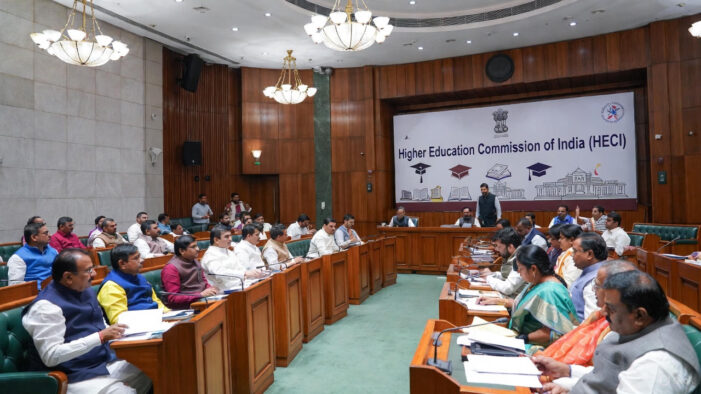
In what could be the most significant structural reform in Indian higher education in decades, the Central government is reportedly preparing to table a landmark bill in the upcoming Parliament session. The legislation seeks to dissolve the University Grants Commission (UGC) and the All India Council for Technical Education (AICTE) and replace them with a single, unified national regulator—the Higher Education Commission of India (HECI).
If passed, this will mark the end of a dual-regulatory era that began in 1956 with the UGC Act and was later expanded with the creation of AICTE in 1987.
Why Now?
The rationale is straightforward and long overdue:
- Reduce regulatory cholesterol: Institutions currently navigate overlapping jurisdictions, multiple inspections, and conflicting guidelines.
- Speed up approvals: From starting new courses to granting deemed-university status, the present system is notoriously slow and opaque.
- Shift from input-based to outcome-based regulation: The new body is expected to focus on learning outcomes, research output, and global rankings rather than merely counting faculty seats and square footage of libraries.
- Bring coherence to a fragmented ecosystem: India has 1,113 universities and over 43,000 colleges (AISHE 2021–22), yet we still lack a truly unified quality framework.
What Changes on the Ground?
Expected highlights of the proposed HECI (based on earlier drafts and recent statements):
- Single-window regulation
One regulator, four verticals:
- Academic standards & accreditation
- Funding & resource allocation
- Regulation of fees and professional ethics
- Technical education oversight (absorbing AICTE’s role)
- Graded autonomy revisited
Top-performing institutions (the original “Category I” and “II” universities under UGC’s old graded autonomy rules) will enjoy near-complete academic, administrative, and financial freedom. - Binary regulation for professional courses
Instead of pre-approval for every new B.Tech or MBA programme, institutions with strong NAAC/NIRF credentials may only need post-facto reporting. - Stronger enforcement teeth
Penalties for false declarations, misrepresentation of facilities, or fake degrees are likely to be steeper. - Funding decoupled from regulation
A controversial but important move: the grant-giving function may shift to a separate body (possibly Rashtriya Uchchatar Shiksha Abhiyan—RUSA 2.0), reducing the regulator’s conflict of interest.
The Numbers That Justify the Overhaul
- 690+ universities and 34,000+ colleges (AISHE 2021–22 latest published)
- Only 40 Indian universities in QS World University Rankings 2025 top 1,000
- Gross Enrolment Ratio (GER) crossed 28%, but quality remains uneven
- Over 70% of engineering seats went vacant in several states in 2024—sign of supply–demand mismatch and credibility crisis
The Critics Are Already Loud
State governments fear further centralisation.
Private players worry about “one-size-fits-all” rigidity.
Faculty unions are anxious about loss of UGC-era job security safeguards.
Technical institutions (especially the IIMs and newer private engineering colleges) are concerned that merging AICTE’s specialised oversight into a broader body may dilute domain expertise.
Will This Be NEP 2020’s Biggest Win?
The National Education Policy 2020 explicitly called for a “single regulator for all higher education, excluding medical and legal education.” Five years after NEP was unveiled, the HECI Bill will be the litmus test of political will.
If the government manages to push it through the winter session (or budget session 2026 at latest), India could finally move from a licence-permission-inspector raj era to a light-but-firm, disclosure-based, outcome-oriented regulatory regime.
That would be genuinely transformative.
For students, it could mean more innovative programmes, faster roll-outs, and (hopefully) better teaching.
For institutions, less paperwork and more accountability.
For India, a realistic shot at getting multiple universities into the global top-100 by 2040.
The bill is coming.
The question is: will it be bold enough, or will it get diluted into yet another half-measure?
Watch this space.
And if you’re in the higher education ecosystem—start preparing your submissions to the parliamentary standing committee. Your voice will matter more than ever.

Higher Education Regulator Overhaul: One Regulator to Rule Them All? added by AdminEdu on
View all posts by AdminEdu →