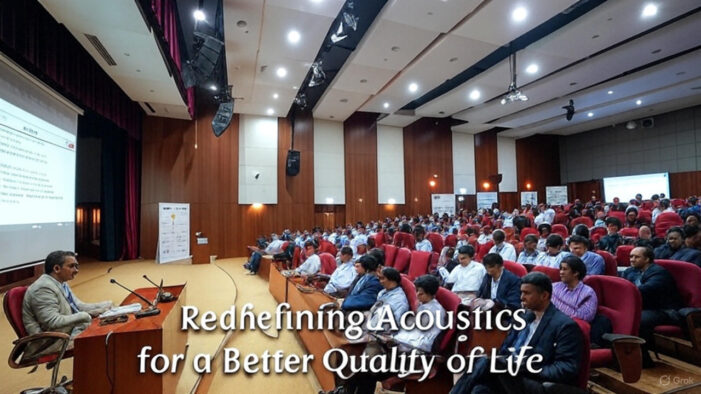
In a world increasingly dominated by urban clamour, where the hum of traffic, the buzz of gadgets, and the roar of construction blur into a relentless soundscape, one question lingers: How can we harness the invisible waves of sound to foster harmony rather than discord? Enter the India International Symposium on Acoustics (IISA 2025), a ground-breaking three-day gathering that just wrapped up at KIIT College of Engineering in Gurugram, Haryana. From October 30 to November 1, 2025, this event brought together global minds to explore “Acoustics Science and Technology for Quality of Life”—a theme that underscores sound’s profound role in shaping our well-being, sustainability, and societal progress.
As the echoes of the symposium fade, it’s worth diving deep into what made IISA 2025 a pivotal moment for acousticians, engineers, and visionaries alike. This wasn’t just a conference; it was a symphony of ideas, blending cutting-edge research with real-world applications to quiet the chaos of modern life. Let’s unpack the highlights, the luminaries who graced the stage, and the transformative discussions that promise to ripple far beyond Gurugram’s vibrant skyline.
The Stage: KIIT College of Engineering and a Legacy of Innovation
Nestled in the bustling yet culturally rich city of Gurugram—home to historic landmarks, multinational hubs, and lively markets—KIIT College of Engineering stands as a beacon of technical excellence. Part of the esteemed KIIT Group of Colleges, the institution has long championed interdisciplinary education, fostering environments where engineering meets human-centric design. Under the leadership of Dr. S.S. Aggarwal, Director General of the KIIT Group, the college has evolved into a hub for forward-thinking events that bridge academia and industry.
Co-organizing IISA 2025 with the Acoustical Society of India (ASI)—the premier professional body for acousticians in the country—the event was a testament to collaborative spirit. ASI, led by President Dr. D.K. Aswal, has been instrumental in advancing acoustics research since its inception, and this symposium marked a milestone in international outreach. With General Chair Dr. S.S. Aggarwal and General Co-Chair Dr. Mahavir Singh at the helm, the event drew over 200 participants, including scientists, researchers, and industry leaders from more than 20 nations. Delegates hailed from diverse corners like France, the UK, the US, Japan, Australia, Germany, and Nepal, creating a truly global chorus of perspectives.
Gurugram’s setting added a poetic layer: a city where ancient Haryanvi traditions coexist with futuristic skyscrapers, mirroring the symposium’s fusion of timeless acoustic principles with tomorrow’s technologies. Attendees raved about the venue’s state-of-the-art facilities, from echo-free auditoriums to interactive demo zones showcasing noise-control innovations.
Unveiling the Theme: Acoustics as the Unsung Hero of Quality of Life
At its core, IISA 2025 wasn’t about decibels or frequencies in isolation—it was about people. The theme, “Acoustics Science and Technology for Quality of Life,” spotlighted how sound influences everything from mental health to environmental sustainability. As Dr. Aggarwal eloquently put it during the inauguration, “Sound is an energy that brings harmony to life. Acoustics can be the foundation of a peaceful and productive society.” In an era of rising noise pollution—linked to stress, sleep disorders, and even cardiovascular issues—this focus felt urgent and timely.
The symposium’s program was meticulously curated to span acoustics, ultrasonics, and vibration, with plenary sessions, technical paper presentations, and workshops. Over 100 high-level papers were submitted, covering breakthroughs in sound engineering that directly enhance daily living. Topics ranged from AI-driven solutions to bioacoustics, emphasizing practical impacts like smarter urban planning and healthier workspaces.
One standout plenary featured a delegation from the Institute of Acoustics (IoA), UK, including Mary-Jane Newton (Executive Director, Education & Digital Strategy), Alistair Somerville (Immediate Past President), and Paul Shields (President Elect). Their presence not only elevated the discourse but also forged potential collaborations, such as joint research on vibration control in seismic zones—a nod to India’s vulnerability to earthquakes.
Day-by-Day Highlights: From Noise to Nirvana
Day 1: Inauguration and the Human Side of Sound (October 30)
The event kicked off with a ceremonial inauguration led by Chief Guest Kevin Cormier, a renowned acoustics expert from AECOM, France. Cormier’s address set a contemplative tone: “Real change will happen when we combine technological knowledge with human understanding and acknowledge the emotional value of sound.” He cautioned against over-relying on AI, stressing that “true creativity and solutions stem from human insight,” and positioned acoustics as a bridge between engineering and empathy.
Early sessions delved into the health ramifications of noise exposure. A compelling presentation on “Health Effects of Noise on Bus Drivers” highlighted how chronic exposure leads to hypertension and reduced cognitive function, drawing from longitudinal studies in urban India. Another talk, “AI-Based Bird Sound Recognition,” showcased machine learning models that monitor biodiversity through audio signatures—vital for conservation in noise-polluted habitats.
Interactive exhibits stole the show, with companies like Himalayan Acoustics demonstrating soundproofing panels made from sustainable materials. These weren’t gimmicks; they were prototypes for affordable noise barriers in schools and hospitals, directly tying back to quality-of-life improvements.
Day 2: Oceans, Cities, and the Language of Sound (October 31)
As the symposium gained momentum, discussions turned oceanic and urban. Experts unpacked the “Impact of Noise on Marine Life and Industry,” focusing on underwater cacophony from pile driving in coastal developments. Researchers from Denmark and Portugal presented data on how vibrational noise disrupts whale migrations, proposing bio-inspired dampeners to mitigate harm— a critical intervention for India’s expanding ports.
Shifting gears, sessions on “The Role of Sound in Language Technology” explored how acoustics powers voice assistants and speech therapy tools. Japanese delegates shared advancements in ultrasonic imaging for non-invasive medical diagnostics, while Australian teams discussed vibration-based early warning systems for bushfires.
Dr. Aswal’s keynote reinforced the theme: “Acoustics today plays an important role in improving the quality of life through applications in smart cities, healthcare, and transportation.” Panelists debated integrating acoustic sensors into India’s Smart Cities Mission, envisioning quieter metros with real-time noise mapping.
Day 3: Visions for a Sustainable Sonic Future (November 1)
The finale buzzed with forward-looking optimism. Workshops on “Noise Control Innovations” featured hands-on demos of metamaterials that absorb sound waves like sponges, potentially revolutionizing aircraft cabins and concert halls. A roundtable on “Acoustics for Social Well-Being” brainstormed policy recommendations, from schoolyard silencers to hospital hush zones.
Dr. Neelima Kamrah, Registrar of the KIIT Group, closed with a poignant reflection: “A better sound environment not only improves mental health but also enhances productivity and comfort in daily life. This symposium marks an important step toward establishing the meaningful role of acoustics in promoting peace, health, and well-being.” The day ended with networking receptions, where exhibitors like those from Switzerland and Indonesia pitched collaborative ventures, hinting at spin-off projects for sustainable development.
Global Voices, Local Impact: Why IISA 2025 Matters
What elevated IISA 2025 beyond a typical academic meet was its diversity and applicability. With experts from 20 countries, the event fostered cross-cultural exchanges—think a Russian ultrasonics specialist collaborating with an Indian marine biologist on anti-submarine noise tech. Participants hailed these interactions as “the need of the future,” especially for emerging challenges like climate-induced acoustic shifts in ecosystems.
For India, the symposium aligns with national priorities: reducing urban noise under the National Clean Air Programme and leveraging acoustics for Atmanirbhar Bharat (self-reliant India) through indigenous tech. Outcomes include proposed ASI-KIIT research labs and a call for acoustics curricula in engineering degrees—steps toward embedding sound science in education.
Tuning into Tomorrow: The Lasting Resonance
As IISA 2025 concludes, its vibrations linger. In a post-event survey (informally buzzing on social channels), attendees voted overwhelmingly for more such symposia, with one delegate noting, “This isn’t just about silencing noise; it’s about amplifying human potential.” By spotlighting acoustics’ role in mental health, environmental stewardship, and innovation, the event has planted seeds for a quieter, more equitable world.
For those inspired, keep an ear to the ground: The proceedings will soon be published via ASI, and KIIT plans follow-ups in 2026. In the meantime, reflect on your own soundscape—what one small change could tune your life for better quality?
What are your thoughts on acoustics’ hidden powers? Drop a comment below—let’s keep the conversation echoing.
Sources: Official IISA 2025 website and SkillOutlook coverage.

Echoes of Innovation: How KIIT College’s IISA 2025 is Redefining Acoustics for a Better Quality of Life added by AdminEdu on
View all posts by AdminEdu →