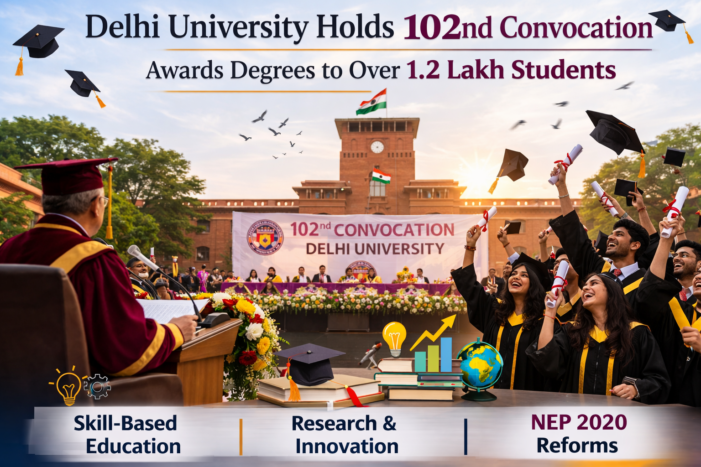
Delhi University (DU) marked a significant academic milestone by hosting its 102nd Convocation, conferring degrees on more than 1.2 lakh graduating students across undergraduate, postgraduate, and doctoral programmes. The ceremony reflected the university’s growing emphasis on academic excellence, employability, and research-driven education.
A Record-Breaking Academic Milestone
This year’s convocation witnessed one of the largest graduating batches in the university’s history. Students from diverse disciplines, including arts, science, commerce, law, and professional studies, received their degrees in recognition of successful completion of academic requirements.
University authorities highlighted that the large number of graduates demonstrates expanding access to higher education and steady growth in student enrolment.
Focus on Skill-Based Education
A key theme of the convocation was the importance of skill-oriented learning to meet evolving industry and societal needs. DU reiterated its commitment to:
- Introducing multidisciplinary courses
- Expanding vocational and internship-linked programmes
- Strengthening industry-academia partnerships
Officials noted that skill-based education would play a crucial role in improving student employability and supporting India’s demographic dividend.
Strengthening Research and Innovation
The university also underscored its push toward enhancing research output and innovation capacity. Steps taken in recent years include:
- Establishing new research centres
- Encouraging student participation in funded research projects
- Promoting publication in reputed journals
- Supporting innovation and entrepreneurship through incubation hubs
These efforts aim to position DU as a leading contributor to India’s knowledge economy.
Alignment with National Education Reforms
The convocation reflected the broader goals of India’s higher education reforms under the National Education Policy (NEP) 2020, which emphasizes:
- Multidisciplinary education
- Flexible curricula and academic mobility
- Research-led universities
- Holistic student development
The university leadership stated that reforms are being implemented in phases to improve quality, access, and global competitiveness.
UPSC Angle
1. Higher Education Reforms
- Focus on autonomy of universities
- Shift from rote learning to competency-based education
- Promotion of research universities and innovation clusters
2. GER (Gross Enrolment Ratio)
- India aims to raise GER in higher education to 50% by 2035
- Large-scale convocations reflect widening access but also highlight the need for quality assurance
3. National Education Policy 2020
- Multidisciplinary and flexible degree structures
- Integration of vocational education with mainstream academics
- Strengthening teacher training and research funding
4. Governance and Quality
- Role of central universities in implementing reforms
- Importance of accreditation, ranking systems, and outcome-based education

Delhi University Holds 102nd Convocation, Awards Degrees to Over 1.2 Lakh Students added by AdminEdu on
View all posts by AdminEdu →