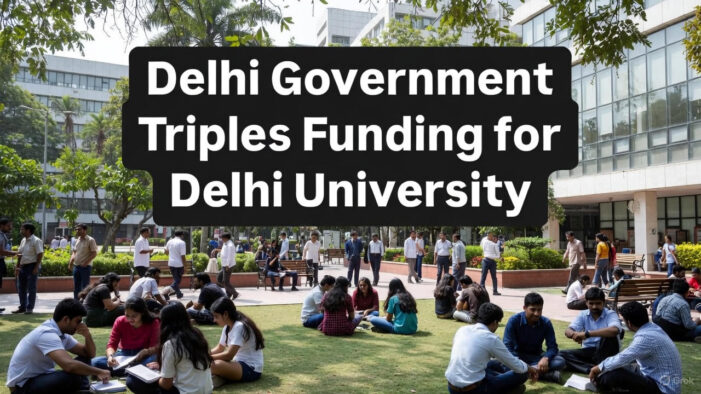
In a significant move for higher education in the capital, the Aam Aadmi Party (AAP)-led Delhi government has announced an allocation of ₹100 crore for the 12 Delhi University colleges fully or largely funded by the GNCTD (Government of National Capital Territory of Delhi) in the financial year 2025–26.
This marks a dramatic increase from the ₹32 crore these colleges received in 2014–15 — effectively tripling the funding in a decade.
Breaking Down the Numbers
- 2014–15 (pre-AAP era): ₹32 crore
- 2025–26 (current allocation): ₹100 crore
- Increase: More than 212% in nominal terms
Even after adjusting for inflation, the real-terms growth is substantial and reflects a deliberate policy shift toward strengthening publicly funded higher education.
Where Will the Money Go?
According to statements from the Delhi government and Delhi University officials, the enhanced grants will primarily be used for:
- Infrastructure upgrades: New classrooms, modern laboratories, library expansion, and campus Wi-Fi
- Faculty and staff salaries: Addressing long-standing delays and ensuring parity with central university scales
- Student scholarships and financial aid: Expanding merit-cum-means schemes and free coaching for competitive exams
- Research and innovation hubs: Setting up startup incubators and research facilities in several colleges
Why This Matters
Delhi University’s government-funded colleges (such as Deen Dayal Upadhyaya College, Bhagini Nivedita College, Shaheed Sukhdev College of Business Studies, and Maharaja Agrasen College, among others) cater to a large number of students from middle-class and lower-middle-class backgrounds. For years, these colleges operated on shoestring budgets compared to the centrally funded DU colleges like Hindu, SRCC, or St. Stephen’s.
The chronic underfunding led to:
- Delayed salary payments for ad-hoc teachers
- Outdated laboratories and libraries
- Limited scholarship support
The new ₹100-crore package is the strongest signal yet that the Delhi government wants to bridge this gap and bring its colleges at par — or at least much closer — to the flagship institutions of the university.
Political Context (Because Let’s Be Honest)
The announcement comes months ahead of the Delhi Assembly elections expected in early 2025. Higher education, particularly Delhi University, has always been a key electoral issue in the capital. AAP has consistently positioned itself as the champion of “free and quality education” — from free electricity and water to mohalla clinics and now a massive push for college infrastructure.
Critics will undoubtedly call it election-year populism. Supporters will point out that the funding trajectory has been consistently upward since 2015, regardless of the election calendar.
Whatever the political lens, students and faculty on the ground are likely to welcome the move.
The Road Ahead
While ₹100 crore is a leap forward, Delhi University’s overall annual budget runs into several thousand crores, with the bulk still coming from the University Grants Commission (UGC) and the central government. The Delhi government’s contribution remains a fraction of the total pie.
But for the 12 GNCTD-funded colleges and their roughly 1 lakh students, this tripling of funds could be transformative.
As one DU professor put it (anonymously, of course):
“Finally, we might stop feeling like the neglected stepchildren of the university.”
Here’s hoping the money reaches the classrooms — and stays there.
What do you think — is this a genuine game-changer for Delhi’s government colleges, or just pre-election optics? Drop your thoughts in the comments.

Delhi Government Triples Funding for Delhi University: ₹100 Crore Boost Signals Major Push for Higher Education added by AdminEdu on
View all posts by AdminEdu →