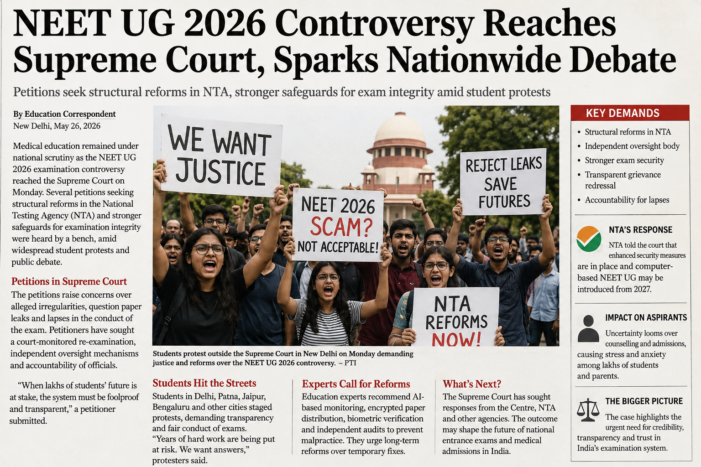
Medical education in India has come under intense national scrutiny after the controversy surrounding the NEET UG 2026 examination reached the Supreme Court. Multiple petitions demanding structural reforms in the examination system, stronger safeguards against paper leaks, and greater accountability from the National Testing Agency (NTA) have triggered widespread public debate and student protests across the country.
The issue has once again raised serious questions about the credibility and transparency of India’s largest medical entrance examination, which is taken annually by more than 22 lakh aspirants seeking admission to undergraduate medical programmes.
Supreme Court Hears Petitions on NTA Functioning
The Supreme Court recently heard a series of petitions related to alleged irregularities and paper leak concerns linked to NEET UG 2026. Several petitioners urged the court to direct major reforms within the National Testing Agency, while some sought a court-monitored re-examination process and independent oversight mechanisms for national entrance tests.
Medical associations, student groups, and legal representatives argued that repeated controversies surrounding competitive examinations have weakened public confidence in the current system. Petitioners also called for stricter accountability measures and enhanced digital security protocols to protect the integrity of future examinations.
Reports submitted before the court highlighted concerns over question paper handling, examination centre monitoring, and delayed institutional responses to allegations of malpractice. The court reportedly sought responses from the Centre, the NTA, and investigative agencies regarding the measures being taken to address the controversy.
Student Protests and Public Reaction Intensify
The controversy sparked protests and demonstrations in several cities, including Delhi, Patna, Jaipur, and Bengaluru, where students and parents demanded fairness and transparency in the admission process. Aspirants expressed concerns about the emotional and academic stress caused by uncertainty surrounding one of the country’s most competitive examinations.
Social media platforms were flooded with discussions on examination integrity, while student organisations demanded long-term institutional reforms rather than temporary corrective actions. Many aspirants argued that repeated controversies surrounding entrance examinations have affected trust in the merit-based selection process.
Calls for Structural Reforms in Examination System
Education experts and policy analysts have recommended a series of reforms aimed at improving the security and credibility of national examinations. Suggested measures include encrypted digital paper distribution, biometric verification of candidates, AI-enabled surveillance systems, stricter monitoring of examination centres, and independent auditing mechanisms.
The NTA informed the Supreme Court that additional safeguards and enhanced security measures are being introduced for future examinations. Authorities also indicated that a transition towards computer-based testing for NEET UG could be implemented from 2027 as part of broader modernization efforts.
Medical Admissions Face Uncertainty
The ongoing legal proceedings and examination-related concerns have created uncertainty for thousands of medical aspirants awaiting counselling schedules and admission updates. Coaching institutes and educational counsellors reported increased anxiety among students preparing for upcoming entrance examinations.
Medical colleges and educational institutions are also closely monitoring developments, as any major policy or judicial intervention could affect admission timelines and examination procedures in the coming months.
Experts believe that the outcome of the Supreme Court proceedings may influence the future structure of national entrance examinations and lead to wider reforms in India’s examination ecosystem.

NEET UG 2026 Controversy Reaches Supreme Court, Sparks Nationwide Debate on Exam Reforms added by AdminEdu on
View all posts by AdminEdu →