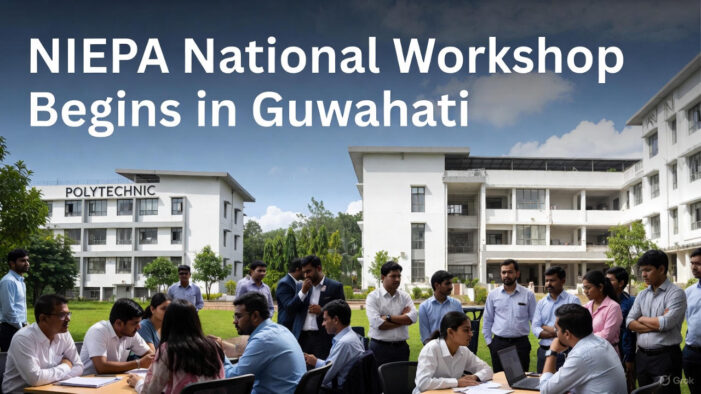
A major three-day national workshop on the future of technical education got underway today in Guwahati. Organized by the National Institute of Educational Planning and Administration (NIEPA), New Delhi, in partnership with the Directorate of Technical Education, Assam, the event brings together policymakers, educators, and industry experts to rethink the role of polytechnics in a fast-changing economy.
The theme is clear and urgent: How do we turn India’s 3,500+ polytechnics into world-class skill hubs?
Why This Matters Now
India wants to become a $5 trillion economy and a fully developed nation (Viksit Bharat) by 2047. That goal depends heavily on millions of skilled technicians, supervisors, and entrepreneurs — exactly the people polytechnics are meant to produce.
Yet most polytechnics still face:
- Outdated courses that don’t match industry needs
- Weak industry connections
- Low student enrolment, especially among girls and Northeast students
- Shortage of trained faculty and modern workshops
The National Education Policy (NEP) 2020 and the National Credit Framework offer a once-in-a-generation chance to fix these issues. This workshop is designed to turn policy into action.
Day 1 Highlights (November 25)
The workshop was inaugurated by Prof. Kumar Suresh Rao, Vice-Chancellor (i/c), NIEPA, along with Shri Dharmendra Das, Director of Technical Education, Assam.
Prof. Rao set the tone in his address:
“Polytechnics should no longer be seen as just diploma factories. They must become vibrant centers of practical skills that respond directly to what industries — and local communities — actually need.”
Shri Das shared Assam’s success story: the state has already launched new diploma programs in Electric Vehicles, Renewable Energy, and Drone Technology, and is upgrading all 22 government polytechnics with modern labs and equipment.
What’s Being Discussed
Over the three days, participants are diving deep into five big areas:
- Modernizing the curriculum
Making diploma programs flexible, credit-based, and aligned with the National Credit Framework. - Stronger industry ties
Mandatory internships, apprenticeship-linked diplomas, and active industry boards in every polytechnic. - Better teachers and leaders
Training faculty and principals in AI, robotics, green skills, and new-age teaching methods. - Upgrading infrastructure
Using central and state funds to build smart classrooms, advanced workshops, and startup incubators. - Reaching more students
Special efforts to bring in girls, tribal students, and youngsters from the Northeast.
Voices from the Floor
- Dr. Janmenjoy Pal, Principal, Assam Engineering College:
“Finally, we have a clear roadmap to implement NEP 2020 on the ground. The idea of offering B.Voc degrees and multiple entry-exit options in polytechnics is a game-changer.” - A faculty member from Dibrugarh Polytechnic:
“Polytechnics have been the forgotten middle layer for too long. This workshop puts us right at the heart of India’s skill revolution.”
What’s Next (November 26–27)
The coming days will include:
- Expert sessions by NIEPA professors
- Success stories from states like Tamil Nadu, Karnataka, and Odisha
- Group work to draft a practical “Polytechnic Reform Roadmap 2030”
- A closing ceremony where states will announce their commitments
The Bigger Picture
India needs to skill over 400 million people in the next decade. With capacity for nearly 1.2 million students every year, polytechnics are perfectly placed to bridge the gap between school and high-end engineering — while delivering immediate, job-ready talent to factories, startups, and service sectors.
The Guwahati workshop is not just talk. It’s the starting point for real, on-the-ground change.
Stay with us — we’ll bring you the key recommendations and state-level pledges as soon as they’re announced.

Transforming Polytechnics for a Skilled India: NIEPA National Workshop Begins in Guwahati added by AdminEdu on
View all posts by AdminEdu →