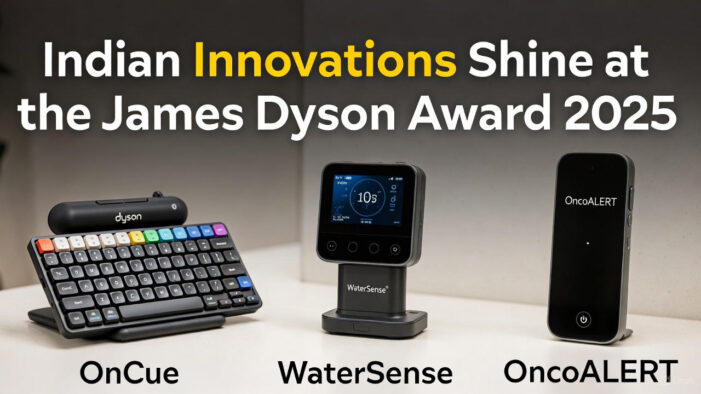
On November 19, 2025, the James Dyson Award announced its global winners in a fully virtual ceremony. More than 2,100 student and recent-graduate projects from 28 countries competed for the prestigious prize — and Indian talent made the country proud.
While the two overall global winners came from Poland and the Netherlands, India achieved a historic milestone: for the first time, an Indian project reached the international shortlist of 20 finalists.
Here are the standout stories from this year’s award.
The Global Winners
Medical Category Winner: OnCue
Created by Alessandra Galli (Italy / Delft University of Technology, Netherlands)
An adaptive keyboard + haptic wristband system designed specifically for people with Parkinson’s disease.
- Gentle vibrations and visual cues help overcome hand tremors and “freezing” episodes.
- Users can type accurately again, stay connected, and regain independence.
Prize: £30,000 to further develop the product.
Sustainability Category Winner: WaterSense
Created by Filip Budny (Poland)
A floating, solar-powered buoy that monitors river pollution in real time and predicts contamination up to 72 hours in advance using AI and low-cost paper sensors.
- Already deployed at 20 sites in Poland (live data: watermap.pl)
- Highly relevant for India’s polluted rivers like the Ganga and Yamuna.
Prize: £30,000
India’s Historic Finalist: OncoALERT
Developed by Jayanti Kumari at the Translational Health Science and Technology Institute (THSTI), India
A portable, AI-powered device that detects early cancer signals from a simple saliva sample.
- Designed for rural and low-resource clinics where advanced diagnostics are unavailable.
- Fast, affordable, non-invasive screening that could save countless lives.
OncoALERT made it to the global top 20 — the first Indian project ever to achieve this.
Why This Matters for India
- Parkinson’s affects over 500,000 people in India; solutions like OnCue show what empathetic design can do.
- River pollution is a daily crisis in many states; WaterSense-style technology could be adapted here.
- OncoALERT proves Indian students and researchers can compete (and lead) on the world stage.
Sir James Dyson summed it up perfectly:
“These inventions solve real problems in clever, practical ways. I hope the prize money helps turn them into products that reach the people who need them most.”
For young Indian engineers and designers, 2025 sent a clear message: the world is watching — and it’s ready for your ideas.
Have an invention that could change lives? The next James Dyson Award is already open. Go build it.
Learn more and enter: jamesdysonaward.org

Indian Innovations Shine at the James Dyson Award 2025 added by AdminEdu on
View all posts by AdminEdu →