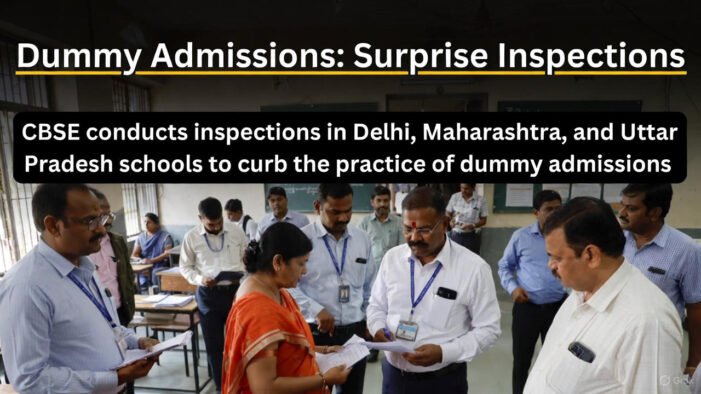
In a bold move to safeguard the integrity of secondary education in India, the Central Board of Secondary Education (CBSE) has launched surprise inspections across the country. Targeting the menace of “dummy admissions”—fake enrolments used to inflate student numbers and secure undue benefits—the board checked 15 schools in seven states, including major hubs like Delhi, Maharashtra, and Uttar Pradesh. Non-compliant institutions now stare at the grim prospect of derecognition, a penalty that could disrupt the academic futures of over 1.3 lakh students enrolled in CBSE-affiliated schools nationwide.
What Are Dummy Admissions?
Dummy admissions refer to the fraudulent practice where schools enroll fictitious students on paper to:
- Boost affiliation status: Higher enrollment figures help schools meet CBSE’s infrastructure and faculty requirements.
- Secure government grants: Many states allocate funds based on student headcount.
- Evade scrutiny: Inflated numbers mask deficiencies in facilities or teaching staff.
This isn’t just administrative sleight-of-hand—it’s a direct assault on educational quality. Real students suffer from overcrowded classrooms (when numbers are fudged the other way), underqualified teachers, and substandard facilities, all while fake records siphon resources.
The Crackdown: 15 Schools, 7 States
CBSE’s inspection teams descended unannounced on schools in:
- Delhi
- Maharashtra
- Uttar Pradesh
- And four other states (specifics withheld to protect ongoing probes)
The checks focused on:
- Physical verification of enrolled students against attendance registers.
- Cross-checking admission forms with Aadhaar and other identity proofs.
- Infrastructure audits to ensure facilities match reported enrollment.
Preliminary reports suggest discrepancies in over 20% of verified records, with some schools unable to produce even basic documentation for hundreds of “students.”
The Stakes: Derecognition and 1.3 Lakh Students
For schools found guilty, derecognition is the ultimate sanction. This means:
- Loss of CBSE affiliation.
- Inability to conduct board exams.
- Students forced to transfer mid-session, often to already burdened government schools.
With 1.3 lakh students across CBSE’s 28,000+ affiliated institutions potentially affected by ripple effects, the human cost is staggering. Parents in affected areas are already voicing concerns:
“My child is in Class 10. If the school loses affiliation, where do we go?” — Parent, Noida (Uttar Pradesh)
Why Now?
CBSE’s aggressive stance follows:
- Rising complaints from whistleblowers and rival institutions.
- Data anomalies flagged during annual affiliation renewals.
- Pressure from the Ministry of Education to align with National Education Policy (NEP) 2020’s emphasis on transparency.
This isn’t the board’s first rodeo—similar drives in 2018 and 2021 led to 87 schools losing affiliation—but the scale and speed of 2025’s operation signal zero tolerance.
The Road Ahead
CBSE has issued a 30-day window for inspected schools to submit compliance reports. A special committee will review cases, with final decisions expected by December 2025. Schools can appeal, but the board has warned: “No extensions. No excuses.”
For parents and students:
- Verify your school’s status on the CBSE affiliation portal (cbseaff.nic.in).
- Demand transparency from school management.
- Prepare contingency plans—nearby government or alternative board schools may be options.
Dummy admissions aren’t just a bureaucratic glitch—they erode trust in India’s education system. CBSE’s crackdown is a necessary purge, but its success hinges on swift, fair enforcement. As the dust settles, one thing is clear: the era of fudged numbers is over.
Stay tuned for updates as the inspection saga unfolds.

CBSE Cracks Down on Dummy Admissions: Surprise Inspections Hit 15 Schools added by AdminEdu on
View all posts by AdminEdu →