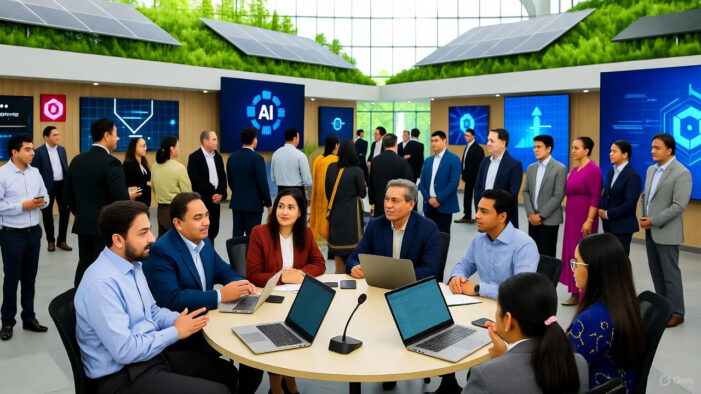
Chandigarh, India – October 24, 2025 – Chandigarh University recently concluded the fifth edition of its Global Education Summit, a landmark event that brought together educators, policymakers, technologists, and thought leaders from across the globe to deliberate on the future of higher education. Held on the university’s sprawling campus, the summit focused on the transformative potential of artificial intelligence (AI), technology-driven learning, inclusivity, and sustainability in shaping the next era of global education.
A Platform for Visionary Dialogue
The Global Education Summit, now in its fifth year, has established itself as a premier forum for addressing pressing challenges and opportunities in higher education. This year’s theme, “Empowering the Future: AI, Technology, Inclusivity, and Sustainability in Higher Education,” underscored the urgent need to adapt academic ecosystems to a rapidly evolving world. The summit featured keynote addresses, panel discussions, workshops, and networking sessions, fostering collaboration among over 500 delegates from more than 30 countries.
In his opening address, Chandigarh University’s Chancellor, Satnam Singh Sandhu, emphasized the pivotal role of technology in democratizing education. “AI and advanced technologies are not just tools but catalysts for creating equitable, accessible, and sustainable education systems,” he said. “Our goal is to prepare students for a world where innovation and inclusivity go hand in hand.”
AI: Redefining Teaching and Learning
A central focus of the summit was the integration of AI into higher education. Experts discussed how AI-powered tools are revolutionizing pedagogy, personalizing learning experiences, and enhancing administrative efficiency. Sessions explored AI’s role in adaptive learning platforms, predictive analytics for student success, and automated assessment systems.
Dr. Maria Alvarez, a renowned AI education researcher from Stanford University, delivered a keynote on “AI as a Co-Teacher: Enhancing Human Potential in Classrooms.” She highlighted how AI-driven platforms can provide real-time feedback to students, enabling tailored learning paths. “AI doesn’t replace educators; it empowers them to focus on mentorship and critical thinking,” Dr. Alvarez noted.
Workshops demonstrated practical applications, such as AI-based virtual tutors and chatbots that support student queries 24/7. Chandigarh University showcased its own AI-driven learning management system, which has reduced dropout rates by identifying at-risk students through predictive algorithms.
Technology-Deepening Education
The summit also delved into how emerging technologies like virtual reality (VR), augmented reality (AR), and blockchain are reshaping higher education. A panel discussion titled “Beyond the Classroom: Immersive Technologies in Learning” featured experts from India, the UK, and Singapore. They explored how VR and AR can simulate real-world scenarios for fields like medicine, engineering, and architecture, offering students hands-on experience without physical constraints.
Blockchain’s potential in securing academic credentials was another highlight. Prof. Anil Gupta, a technology policy expert, explained how blockchain can create tamper-proof digital diplomas, enhancing trust in qualifications globally. Chandigarh University announced a pilot project to issue blockchain-based certificates to its 2025 graduates, positioning itself as a pioneer in this space.
Inclusivity: Bridging Gaps in Education
Inclusivity was a cornerstone of the summit, with discussions centered on making higher education accessible to marginalized communities, differently-abled individuals, and economically disadvantaged students. A dedicated session, “Education for All: Breaking Barriers,” featured inspiring stories of institutions leveraging technology to reach underserved populations.
Dr. Ayesha Khan, a UNESCO education advisor, stressed the importance of digital inclusion. “Access to technology is not enough; we must ensure digital literacy and culturally relevant content,” she said. The summit highlighted Chandigarh University’s initiatives, such as its scholarship programs for economically weaker students and partnerships with NGOs to provide free online courses to rural communities.
The event also addressed gender equity in STEM (Science, Technology, Engineering, and Mathematics) fields. A panel of women leaders in academia shared strategies to encourage female participation, including mentorship programs and targeted scholarships. Chandigarh University’s Women in Tech initiative, which has supported over 2,000 female students in pursuing STEM careers, was lauded as a model for others.
Sustainability: Educating for a Greener Future
Sustainability in higher education was another key theme, with discussions on how universities can lead the charge in addressing climate change. Panels explored sustainable campus practices, green curricula, and research focused on renewable energy and environmental conservation.
Prof. John Carter, an environmental scientist from Australia, delivered a compelling talk on “Universities as Catalysts for Sustainable Development.” He urged institutions to integrate sustainability into every discipline, from engineering to social sciences. Chandigarh University shared its progress toward becoming a carbon-neutral campus, including solar-powered facilities and a zero-waste policy.
The summit also launched the Global Green Education Alliance, a network of universities committed to embedding sustainability in their curricula and operations. Over 50 institutions signed the alliance’s charter, pledging to achieve net-zero emissions by 2035.
Global Collaboration and Innovation
The summit fostered international partnerships, with memoranda of understanding (MoUs) signed between Chandigarh University and universities in Canada, Germany, and Japan. These agreements aim to facilitate student exchanges, joint research, and technology transfer.
A highlight was the Innovation Showcase, where students and faculty presented cutting-edge projects. Standouts included a solar-powered water purification system and an AI-based app for mental health support, both developed by Chandigarh University students. The showcase underscored the university’s commitment to fostering innovation and entrepreneurship.
Looking Ahead
As the fifth Global Education Summit drew to a close, participants left with a renewed sense of purpose. The event underscored the transformative power of AI and technology in creating inclusive, sustainable, and future-ready education systems. Chandigarh University’s leadership in hosting such a forward-thinking summit solidified its reputation as a global hub for educational innovation.
In his closing remarks, Vice-Chancellor Dr. R.S. Bawa called for continued collaboration. “The challenges of the 21st century demand that we work together—across borders, disciplines, and ideologies—to build an education system that empowers every individual,” he said.
The sixth edition of the Global Education Summit is slated for 2026, with plans to explore the intersection of education and emerging fields like quantum computing and bioengineering. As the world grapples with rapid technological and societal changes, Chandigarh University’s summit continues to light the way for a brighter, more inclusive future in higher education.
For more information, contact Chandigarh University’s Media Office at media@chandigarhuniversity.ac.in.

Chandigarh University Hosts Fifth Global Education Summit, Spotlighting AI, Technology, and Inclusive Higher Education added by AdminEdu on
View all posts by AdminEdu →