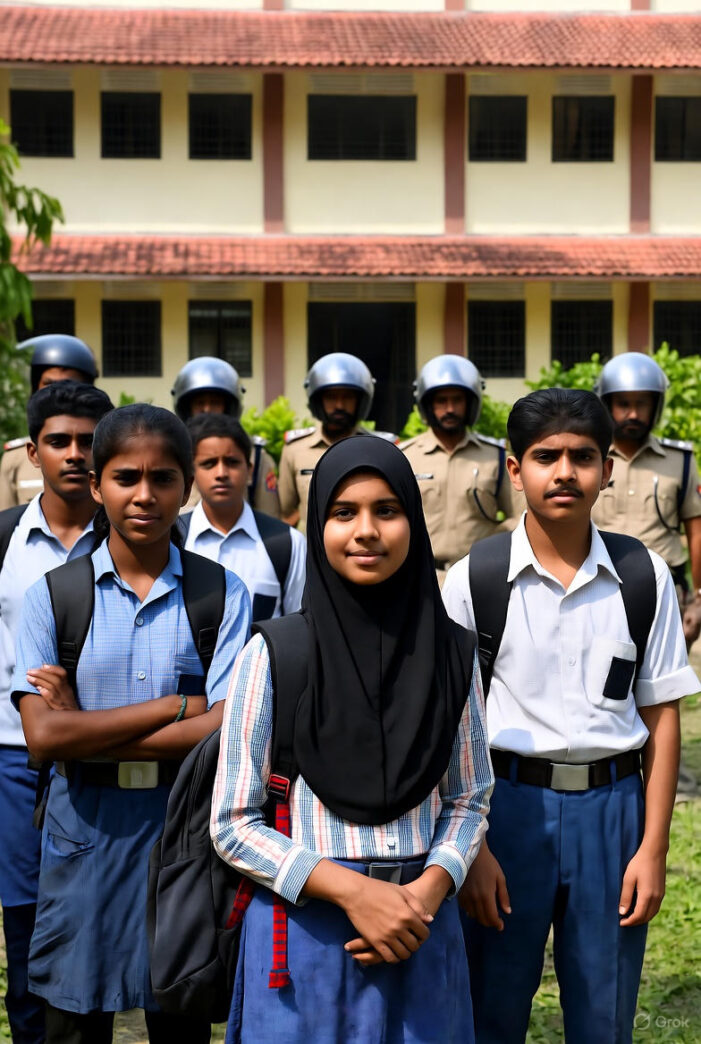
In a development that underscores the delicate balance between institutional autonomy and constitutional rights, St. Rita’s Public School in Palluruthy, Kochi—a CBSE-affiliated institution run by the Latin Catholic Church—resumed classes today under heavy police protection following a two-day shutdown sparked by a dispute over a Muslim student’s hijab. The school’s management has categorically rejected allegations leveled by Kerala General Education Minister V. Sivankutty, labeling a government inquiry report as “factually incorrect” and announcing plans to challenge it in the Kerala High Court.
The controversy erupted earlier this month when an eighth-grade Muslim girl arrived at school wearing a hijab, which the administration deemed a violation of the prescribed uniform policy. The girl, who had joined the school just a couple of months prior, was reportedly denied entry to classes, prompting her father to file a complaint with the Ernakulam Deputy Director of Education (DDE). According to the DDE’s inquiry, the school’s actions constituted “serious misconduct,” breaching the Right to Education (RTE) Act, 2009, and Article 25 of the Indian Constitution, which guarantees freedom of religion.
Tensions escalated rapidly. On October 14, the school declared a two-day holiday—Monday and Tuesday—citing “pressure from the student, her parents, certain individuals not associated with the school,” and mental stress among staff and students. A Parent-Teacher Association (PTA) official alleged that members of the Social Democratic Party of India (SDPI), described as a pro-Islamist group, had backed the parents and created a ruckus at the premises, leading to threats against the mostly nun-led staff. The Kerala High Court, responding to a writ petition from the school, granted interim police protection on October 15, following reports of mob intrusion and security concerns.
Government Intervention and Parental Reversal
The state government swiftly intervened. On October 15, Minister Sivankutty issued a directive based on the DDE report, instructing the school to allow the student to attend classes while wearing the hijab, with the management deciding on its color and design to align with the uniform. “The report states that the school’s action was contrary to the fundamental religious freedoms guaranteed to citizens under the Indian Constitution,” the minister stated in a social media post. He emphasized Kerala’s secular ethos, adding, “No student should face such hardship in a state like Kerala which upholds secular values. No educational institution will be allowed to violate constitutional rights.” The principal and manager were ordered to address the “mental agony” inflicted on the student and her family and submit a compliance report by 11 a.m. the next day.
In a parallel development, a delegation of Congress leaders—including Ernakulam MP Hibi Eden and Tripunithura MLA K. Babu—met the family on October 14, convincing the father to adhere to the school’s dress code to prevent communal polarization. “She will attend classes starting Wednesday. We have decided to abide by the school management’s conditions,” the father said at the time, expressing concerns over external groups exploiting the issue. However, by October 16, the father appeared to reconsider, stating he might now permit his daughter to wear the headscarf in light of the minister’s directive.
Management’s Firm Stand and Legal Recourse
Upon resumption today, Principal Sr. Heleena Alby addressed the media, vehemently denying the minister’s narrative. “The minister made his statement without verifying the facts,” she asserted. “The school had never prevented the student from attending classes, even after the issue emerged in the public domain.” Alby invoked a 2018 Kerala High Court verdict upholding managements’ rights to enforce uniform rules, insisting that St. Rita’s has “never resorted to discrimination” based on religion. The school submitted its reply to the department’s notice today, and PTA President Joshi Kaithavalappil echoed the principal’s sentiments, rejecting the minister’s remarks outright. “The institution’s autonomy must be respected,” Kaithavalappil said, adding that the no-hijab policy applies equally to all students and remains unchanged.
The management has also announced its intent to approach the Kerala High Court against the DDE report, which they deem biased and inaccurate. Notably, the complainant student was absent from classes on the reopening day, amid reports of ongoing deliberations within the family.
Broader Implications in Kerala’s Secular Landscape
This episode has reignited debates on the intersection of religious expression and educational discipline in Kerala, a state long celebrated for its communal harmony. While the minister framed the incident as a clear-cut violation of student rights, critics from the school and conservative groups argue it risks eroding institutional authority. Social media buzz has amplified the divide, with some users accusing political outfits like the SDPI of stoking tensions for electoral gains, while others hail the government’s stance as a defense of minority rights.
Hibi Eden, who mediated the family meeting, warned of legal action against those “trying to communalise the issue on social media,” underscoring the need for consensus at the school level. “If there’s agreement, let it end there. No one should be denied education,” Minister Sivankutty reiterated today, affirming the government’s vigilance.
As the school navigates this storm, the focus remains on ensuring the girl’s uninterrupted education. Whether she returns in uniform or hijab—and how the courts respond—could set precedents for similar disputes in India’s diverse educational ecosystem. For now, classes at St. Rita’s proceed under the watchful eyes of police, a stark reminder of the fragility of secular ideals in the face of faith-based assertions.

St. Rita’s Public School Reopens Amid Kerala Hijab Controversy: Management Rejects Minister’s Claims of Rights Violation added by AdminEdu on
View all posts by AdminEdu →