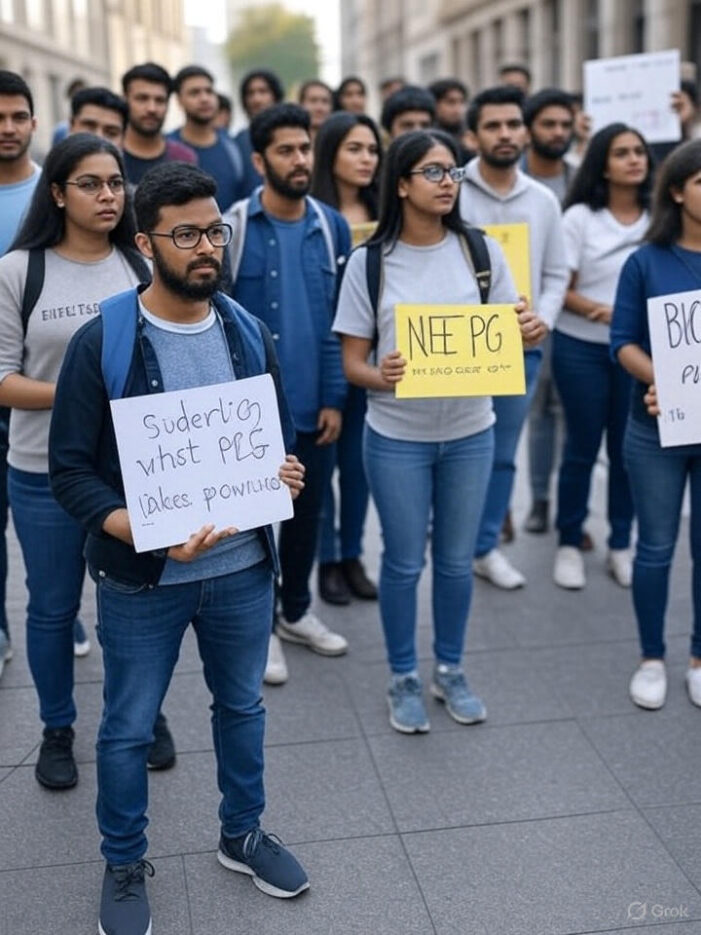
New Delhi, September 24, 2025 – In a highly anticipated hearing, the Supreme Court of India delved into a public interest litigation (PIL) challenging the transparency of the NEET PG 2025 examination process. The case, listed first on the court’s agenda yesterday, September 23, addresses widespread concerns over discrepancies in result disclosures and the National Board of Examinations in Medical Sciences (NBEMS) practices. Aspirants, represented by groups like the United Doctors Front (UDF), argue that the current system undermines fairness in one of the country’s most competitive medical entrance exams.
The NEET PG 2025 exam, conducted on August 3, saw over 2.42 lakh candidates vying for postgraduate seats in MD, MS, and diploma programs. However, post-result announcements have triggered protests, with many reporting score variations of 50 to 150 marks. The bench, comprising Justices JB Pardiwala and KV Viswanathan, is expected to issue directives that could reshape future examination protocols.
Background: From Promises to Partial Disclosures
The controversy erupted following NBEMS’s August 21 announcement, which initially promised the release of full question papers, answer keys, and response sheets – a first for the exam. This move was hailed as a step toward transparency, aligning with earlier Supreme Court directives from April 29, 2025. In that order, a bench led by Justice JB Pardiwala mandated the publication of raw scores, answer keys, and the normalisation formula to enhance accountability.
However, NBEMS issued a “corrective notice” shortly after, restricting disclosures to “Question ID Numbers” from a master paper set. This change, petitioners claim, renders verification impossible since questions and options were shuffled individually for each candidate. “It frustrates the very object of publishing answer keys,” one petition stated, emphasizing the inability to cross-check answers against actual questions.
The PIL, first heard on September 4, was expedited after urgent applications from aspirants. During that session, the court questioned the petitioners’ motives, asking, “Why do you think there is no transparency? Is it because you got less marks?” The bench observed that such pleas sometimes exploit constitutional provisions like Article 32 rather than genuinely seeking systemic improvements. Subsequent hearings on September 12 were postponed, building tension as counselling loomed.
Key Demands: Full Disclosure and Normalisation Clarity
At the heart of the petition are demands for comprehensive reforms:
- Release of Complete Question Papers: Aspirants seek the full set of questions, not just IDs, to enable independent verification.
- Detailed Response Sheets: Individual answer booklets matched to actual questions, allowing objection-raising on discrepancies.
- Transparency in Normalisation: Explanation of the formula used for multi-shift exams, as NEET PG 2025 was held in two shifts despite earlier court suggestions for a single shift.
- No Re-evaluation, Just Verification: Petitioners clarified they are not seeking paper rechecks but verifiable data to ensure evaluation integrity.
The UDF, a key petitioner, has long opposed the two-shift format, arguing it introduces inequities through normalisation. Media reports highlight that NBEMS’s partial disclosures have left candidates unable to confirm scores, fueling distrust in the high-stakes process.
Impact on Counselling: National Hold, State-Level Progress
The ongoing litigation has stalled the All India Quota (AIQ) counselling, managed by the Medical Counselling Committee (MCC). Originally slated for mid-September, the schedule remains on hold pending the court’s order. The MCC is expected to update its website (mcc.nic.in) with a revised timetable shortly after the verdict, potentially starting in late September or early October.
In contrast, state-level counselling has proceeded in select regions. Gujarat, Kerala, and Tamil Nadu have initiated their processes, providing interim relief to local candidates. This patchwork approach has left national aspirants in limbo, with fears of delayed admissions affecting the 2025-26 academic session.
A related plea on transgender reservations in NEET PG admissions was also taken up, underscoring broader equity issues in medical education.
What’s Next: Potential Reforms and Aspirants’ Hopes
The September 23 hearing marks a pivotal moment, with the bench reviewing compliance with prior directives. Legal experts anticipate orders that could enforce stricter transparency norms, possibly including single-shift exams for future cycles. “This isn’t just about one exam; it’s about restoring faith in a system that shapes India’s medical future,” said advocate Avani Bansal, representing the petitioners.
As the court deliberates, aspirants await clarity. Protests continue outside NBEMS offices, with social media campaigns amplifying calls for reform. The outcome could set precedents not only for NEET PG but for other national exams grappling with similar transparency debates.
For updates, candidates are advised to monitor official portals and court listings. The full judgment is expected within days, potentially unlocking the counselling gateway for thousands.

Supreme Court Hears Crucial Petition on NEET PG 2025 Transparency Amid Aspirants’ Protests added by AdminEdu on
View all posts by AdminEdu →